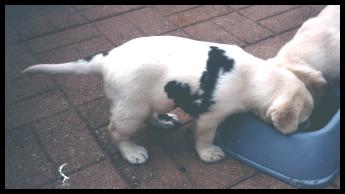
If the patch covers one whole ear, forms
a ring around the neck, covers one rear leg, or forms a Miss America banner
across the chest (all of which have occurred), the dog is obviously not
prime show potential. Showing these dogs to uninformed judges will result
in disqualification or be excused for lack of breed quality.
As for breeding potential; like anything
else, intense pigmentation will he passed along and can be doubled upon,
paving the way for additional spots. It's the old rule of too much of a
good thing. If a dog can have too much head, too much angulation or too
much leg, why can't it have too much pigment? Don't slash your wrists,
just work around it.
There has been so much controversy regarding
the yellows and the various shadings accompanying the nature of the color.
Next time you're at a dog show, take a look at the buff-colored Cockers,
cream Afghans and Golden Retrievers, to name a few canine cousins.
Call the color what you will, the genes
remain the same. The alleles that cause the variations between the breeds
also cause the variations on any given yellow Labrador. Any particular
allele can produce a dark face mask, ticking, dark or light shading, dark
edging on the ears, agouti markings (different bands of color on each hair),
etc., etc. The list is endless. If you're a hysterical purist about color,
there's plenty of material to work on. Otherwise, just realize that a yellow
Labrador is genetically a solid colored dog and all the shading in the
world won't change that fact.
Also, blacks and chocolates can also carry
and exhibit these same shadings. But, their blackness or chocolate-ness
covers or masks these variations allowing them to appear of a more solid
color than the yellows do.
You've seen blacks that were SO black or
rusty brown or grey but they are still black, same with the chocolates.
No; Virginia, it's not sun-bleaching, it's the nature of the beast's color.
Labradors are not so far removed from the
German Shepherd, Rhodesian Ridgeback or the Beagle that the various color
combinations are not a legitimate expression of the breed. We simply choose
to depress some combinations while encouraging others to emerge.
Have you ever marveled at the way things
seem to come out right so much of the time? You know, one eye on each side
of the head, one leg in each corner, the right number of toes, etc. Almost
miraculous, don't you think?
................................................................. |






 ..
..
